Digital Product Passport for textile & apparel

Every garment, traceable from fibre to end of life.

PassTEX turns fragmented supply-chain data into ESPR-ready digital product passports — verifiable, auditable and linked to the physical product by a single QR code.

  • Built for ESPR (EU) 2024/1781
  • Aligned to CEN/CENELEC EN 18216–18223
  • Funded by TÜBİTAK 1501
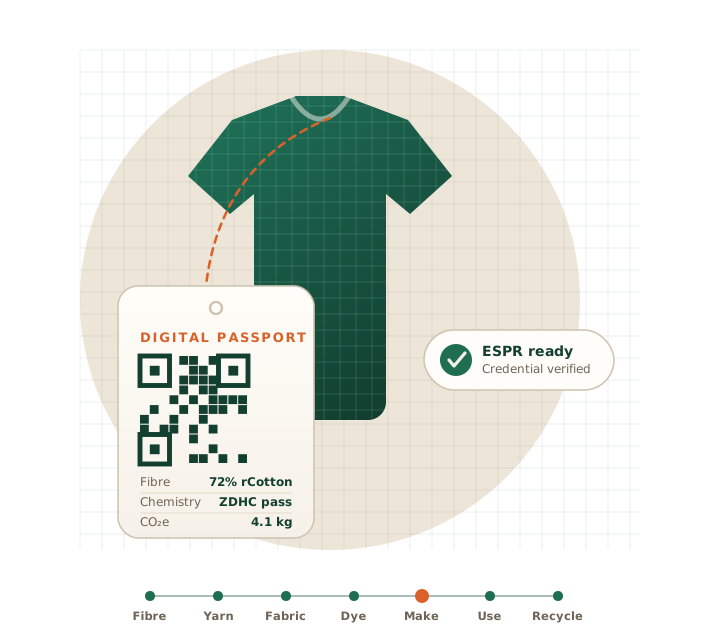
A t-shirt with a digital product passport tag showing fibre composition, chemical compliance and carbon footprint, above a fibre-to-recycling lifecycle strip.

The challenge

The data already exists. It just isn’t in one place.

For textiles — one of Türkiye’s largest export categories — the Digital Product Passport is not merely a technical compliance question. It bears directly on access to the EU market.

Where it lives today

  • Enterprise resource planning systems
  • Manufacturing execution systems
  • Laboratory and test results
  • Supplier declarations
  • Document-based manual processes

Fragmentation raises compliance risk and operational cost at the same time.

What the regulation asks for

  • Product identity
  • Fibre composition
  • Chemical compliance
  • Origin information
  • Carbon and water footprint
  • Recycled content share
  • Repairability and recovery potential

Presented in verifiable form, by every manufacturer shipping to the EU market.

Where the rules stand

The framework stopped being theoretical.

The horizontal machinery is published and the EU registry is live. What is still open for textiles is the product-specific delegated act — which is exactly why PassTEX is built in phases rather than against one fixed schema.

  1. 1 Jan 2025

    Separate textile waste collection

    Mandatory in every Member State, creating the sorting and recovery data that end-of-life records depend on.

  2. 16 Apr 2025

    ESPR working plan 2025–2030 adopted

    Textiles and apparel confirmed as a priority product group, alongside steel and aluminium, furniture, tyres and mattresses.

  3. 16 Oct 2025

    Textile EPR enters into force

    Directive (EU) 2025/1892 introduces the first EU-wide extended producer responsibility framework for textiles and footwear; national schemes due within 30 months.

  4. May – Jul 2026

    Horizontal DPP standards published

    CEN/CENELEC JTC 24 publishes EN 18216 and EN 18219–18223. EN 18220 on data carriers was cited in the Official Journal on 15 July 2026; the two security standards (prEN 18239, prEN 18246) completed formal vote.

  5. 13 Jul 2026

    UNTP public review closes

    The UN Transparency Protocol reached v0.7.0 and closed public review, with v1.0 due 1 September 2026. UN/CEFACT’s garment and footwear work is funded by the European Commission’s DG INTPA through UNECE.

  6. 20 Jul 2026

    EU DPP Registry goes live

    The Commission opened the central registry and its test environment. Implementing Regulation (EU) 2026/1778 took effect on 6 August 2026.

  7. 18 Feb 2027

    Batteries first

    The battery passport is the first mandatory category under the registry — the working reference every later product group is measured against.

  8. 2027 · indicative

    Textiles delegated act

    Sets the product-specific data requirements. Under ESPR, obligations apply at the earliest 18 months after entry into force — realistically 2028–2029 for textiles.

Dates for the textiles delegated act are the Commission’s indicative planning, not law.

How it works

One thread, followed the whole way.

Every stage writes to the same passport as a UNTP Digital Traceability Event — the what, when, where, who and how. Select a stage to see what PassTEX records there.

Fibre production

Where the material came from and what it is made of — the anchor for every claim further down the chain.

  • Fibre origin
  • Material composition
  • Recycled / bio-based share
  • Supplier identity

The platform

Three layers, developed together.

PassTEX treats the passport not as a one-off document but as a phased, modular governance infrastructure that adapts as the regulation matures.

01

Semantic data mapping

Heterogeneous data from every point in the chain is mapped onto a common semantic layer through a textile-specific ontology.

  • JSON-LD aligned to the UNTP Core Vocabulary and Taxonomies
  • EN 18216 exchange and EN 18223 interoperability profiles
  • EN 18219 identifiers, resolved via GS1 Digital Link
  • Standard API connectors for ERP, PLM and PIM
02

Explainable compliance engine

Language models turn regulatory text into machine-readable rules; a knowledge graph makes them queryable; ML models watch for anomalies and score ESG performance.

  • Pre-production scenario analysis
  • Post-production verification
  • Every decision traced to fields and rule chain
03

Verifiable trust layer

Each stakeholder holds its own cryptographic identity, and certificates become credentials a machine can check.

  • W3C Verifiable Credentials 2.0 and Decentralised Identifiers
  • UNTP Conformity Credentials for GOTS and OEKO-TEX
  • Digital Identity Anchors binding DIDs to registered identity
  • Tracking prEN 18239 / prEN 18246 security and integrity
  • Assurance level matched to data class, not one-size-fits-all

Inside a passport

What a scan actually returns.

  • Product identity

    Unique identifier bound to the physical item through a QR code or digital carrier.

  • Fibre composition

    Verified material breakdown, cross-checked against supplier declarations and test reports.

  • Chemical compliance

    Substance inventory and conformance evidence from the wet-processing stages.

  • Origin

    Auditable provenance across every tier of a fragmented, multi-tier supply chain.

  • Carbon & water footprint

    Per-stage consumption rolled up into a product-level figure with visible lineage.

  • Recycled content

    Recycled and bio-based share, evidenced rather than asserted.

  • Durability & repairability

    The information that extends product life and supports repair and resale.

  • Recovery potential

    Recyclability and end-of-life routes, feeding extended producer responsibility reporting.

  • Registry record

    The unique identifier and passport URL lodged in the EU DPP Registry for authority access.

Who it’s for

Two levels of digital maturity, one passport.

Architecture, deployment model, integration strategy and user experience are differentiated for each segment.

Enterprise

Manufacturers & brands with their own IT

Deep integration with the systems you already run, and dashboards for the teams that answer to auditors.

  • Direct ERP, PLM and PIM connectors
  • Web-based management dashboards
  • Data sovereignty preserved across the chain

SME

Suppliers without an IT department

Limited digital maturity should not mean losing access to the EU market. Onboarding is guided and hosted.

  • No infrastructure to run or maintain
  • Guided data entry instead of integration projects
  • Costs proportionate to the assurance actually required

Consumers & resale

Anyone holding the garment

A mobile application gives consumers and second-hand market verifiers access to a product’s sustainability story through the QR code on the label — the same verified record, without an account or a portal.

Built on the published DPP standards

  • ESPR (EU) 2024/1781
  • EN 18216 · exchange
  • EN 18219 · identifiers
  • EN 18220 · data carriers
  • EN 18221 · persistence
  • EN 18222 · APIs
  • EN 18223 · interoperability
  • prEN 18239 / 18246 · security
  • EU DPP Registry
  • UNTP DPP
  • UNTP Traceability Events
  • UNTP Conformity Credentials
  • GS1 Digital Link
  • JSON-LD
  • W3C DID
  • Verifiable Credentials 2.0
  • GOTS
  • OEKO-TEX
  • ZDHC

Roadmap

An 18-month build, in three periods.

Supported by the TÜBİTAK 1501 Industrial R&D Support Programme. Funding period: 1 July 2026 – 31 December 2027.

  1. Period 1

    Foundations

    Requirements analysis, data architecture and the core platform infrastructure.

  2. Period 2

    Interoperability & trust

    The interoperability layer, the decentralised trust infrastructure and the AI components.

  3. Period 3

    Integration & pilots

    User interfaces, the integrated AI engine, system integration and pilot validation with real production data.

FAQ

Questions we get asked.

Do we have to replace our ERP?

No. PassTEX integrates with ERP, PLM and PIM systems through standard API connectors. The platform maps what you already record onto a shared semantic model rather than asking you to re-enter it.

When does this become mandatory for textiles?

The ESPR working plan adopted on 16 April 2025 confirmed textiles and apparel as a priority group, with the delegated act indicatively planned for 2027. Under ESPR, requirements apply at the earliest 18 months after that act enters into force, so 2028–2029 is the realistic window. Two obligations already bite sooner: separate textile waste collection since 1 January 2025, and extended producer responsibility under Directive (EU) 2025/1892, with national schemes due within 30 months of 16 October 2025.

What is the EU DPP Registry, and does it apply to us yet?

It is the Commission’s central directory of every passport on the EU market, holding the unique identifier, the passport URL and metadata for authority access. It opened on 20 July 2026 with a test environment, and Implementing Regulation (EU) 2026/1778 took effect on 6 August 2026. Registration becomes mandatory per product group — batteries first, from 18 February 2027 — so textiles follow with their own delegated act. PassTEX writes registry-shaped records from the start, so nothing has to be retrofitted.

Is this a blockchain product?

No. The trust layer is built on W3C Verifiable Credentials 2.0 — a W3C Recommendation since 15 May 2025 — and Decentralised Identifiers, tracking the CEN/CENELEC security and integrity profiles (prEN 18239, prEN 18246, formal vote closed July 2026) for access and authentication. Assurance levels differ by data class, so the architecture stays proportionate to risk and audit requirements instead of applying one uniform, energy-intensive mechanism to everything.

How do you stop greenwashing?

Claims are backed by evidence rather than assertion. AI-assisted validation cross-checks supplier declarations, test reports and certificates for inconsistencies before they reach the passport, and the explainability layer shows auditors which data fields and which chain of rules produced each result.

Can a supplier with no IT staff take part?

Yes — that is one of the two segments the platform is designed for. SMEs use a hosted deployment with guided data entry, with no infrastructure to run and no integration project to fund.

Where does UNTP fit, and is it stable enough to build on?

The UN Transparency Protocol is UN/CEFACT’s interoperability framework for verifiable value-chain data, and it operationalises UNECE Recommendation 49. PassTEX uses its Core Vocabulary and Taxonomies for semantics, Digital Traceability Events for lifecycle records, Conformity Credentials for certificates, and Digital Identity Anchors for party identity — all inside the W3C Verifiable Credentials 2.0 envelope.

On stability, we are deliberate: UNTP is at v0.7.0, which its authors describe as suitable for pre-production pilots, with v1.0 expected on 1 September 2026 and a textile-specific extension still in draft. So UNTP shapes how PassTEX models data, while the EU obligations — ESPR, the EN 1821x standards and the DPP Registry — drive what has to be filed. The two are complementary by design: UNTP is explicit that it complements rather than replaces regional passport regimes.

Who can see our commercial data?

Data sovereignty is preserved. PassTEX follows the prEN 18239 access-rights model and exchanges data through Gaia-X/IDSA-compatible dataspaces, with UNTP’s discover-resolve-verify pattern so data stays with its owner rather than being centralised. Each participant controls what is shared, with whom, and at what level of detail.
See PassTEX against your own product data.

We run walkthroughs with a real article from your range — a composition, a wet-processing record, a set of certificates — and show what the passport returns.